White Goods 2004
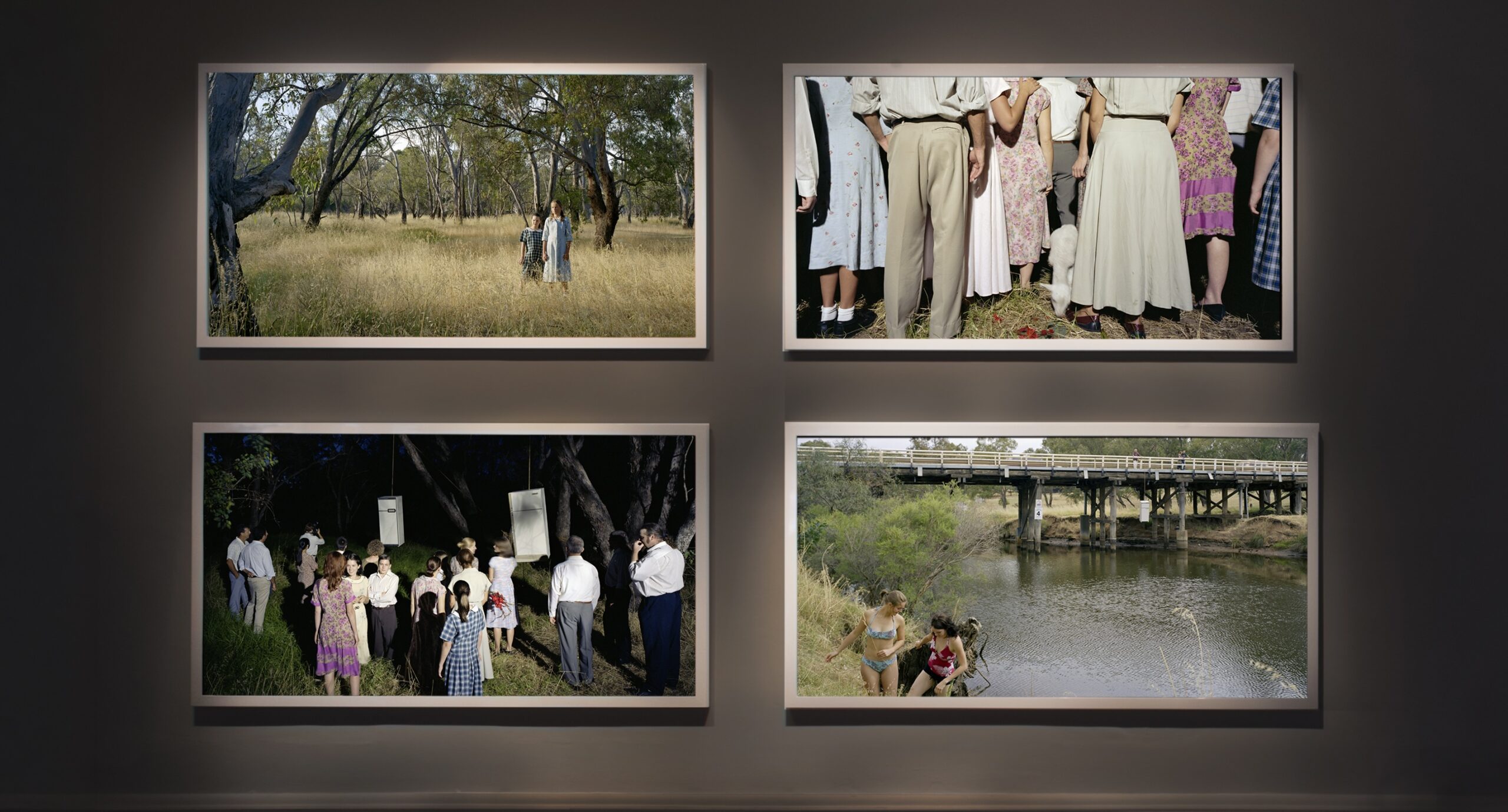
White Goods is a work of speculative fiction; four of the seven images in the series are shown above and were installed at the Perth Institute for Contemporary Arts for the 2015 exhibition Accident and Process. A Visions of Australia touring survey exhibition. From left to right/ top to bottom: White Goods 4, 6, 2, and 3.
“On matters related to race, the Racial Contract prescribes for its signatories an inverted epistemology, an epistemology of ignorance, a particular pattern of localised and global cognitive dysfunctions (which are psychologically and socially functional), producing the ironic outcome that whites will in general be unable to understand the world they themselves have made.”
Mills, C.W. (1997) The Racial Contract. Ithaca: Cornell University Press.


In ‘White Goods’, the scraggly settings, generically Australian rather than specifically local, provide the stage for Kreckler’s Australian story, which operates in a non-didactic, allusive mode to unsettle appearances and worry at viewers. The refrigerator isn’t in a suburban home kitchen where it belongs but has been dislodged and displaced, now appearing ruined. Bizarrely suspended, it evokes an unseen act of violence, either recent (the crowd is still gathered as part of the spectacle, as witnesses and actors in the event) or at some unspecified time in the past (hanging on ropes from Whiteman’s bridge, it doesn’t attract the attention of those enjoying the water or the view and is apparently noticed only by us). In the crowd scenes where the refrigerator hangs, a weird inversion occurs: in the absence of Aboriginal people, in their erasure, the white goods are somehow transposed into a black body. The hanging deaths of Aboriginal people in both the historical past and the contemporary moment come to mind. This is no accident. Kreckler drew from a deep reservoir of historical imagery for the series, including the hugely confronting photographs of lynchings of African Americans published in James Allen’s book Without Sanctuary (1999). What particularly struck Kreckler about the photographs from Allen’s collection was the crowd’s casualness and total lack of empathy for the victims; he incorporated some of the onlookers’ gestures and their groupings into his own choreography.
In his essay ‘Derek Kreckler: Allegories of Vision’ in the 2004 Biennale of Sydney catalogue, Blair French convincingly argues that it isn’t only the white goods metaphor that ‘crystalises in a disturbing fashion’ in relation to hanged bodies. It is also the spaces or sites in the photographs, which serve as a reminder of ‘one of the largest real estate frauds in history’. French writes:
As these images attest, if the wilful cultural amnesia of terra nullius is to be consistently challenged, as it must, there can be no images here in Australia of meaningless, empty spaces. Indeed, there are no spaces left unstained by the events of history or unable in some way to evoke its lingering effects upon our consciousness. This is not to preclude other readings of ‘White Goods’. Isabel Carlos, for example, saw the series as more global than local, more concerned with consumerism than with any particular aspects of Australian history. Of the photographs, she commented that ‘people look at battered fridges as if they were mysterious white gods’. Regardless of where the interpretative emphasis lies, the series communicates a sense of unease and what Kreckler himself describes as ‘dark unknowing’. It is conveyed through the surface prettiness of his palette, the floral prints of the girls’ dresses, and the sweet appearance of the youthful subjects.
Ennis, Helen, ‘Derek Kreckler: Dark knowing” in Hannah Matthews (ed.), Derek Kreckler: Accident and Process, Perimeter Editions